
Most people think shipping a car is just like mailing a heavy package. It is quite different, because vehicles are not put in standard boxes and shipped on a simple conveyor belt..
Moving a car means fitting it to a complex network of safety rules, strict driver hours, and heavy equipment limits. When you understand how the transport system operates behind the scenes, you stop worrying about generic advice..
You start making better decisions about how to prepare your vehicle and how to hand it off safely.
Why distance doesn’t tell the whole story
People usually assume a short trip is automatically an easy trip. This makes sense on the surface but ignores how commercial freight actually works in practice. The controlling factor in moving a vehicle is legal driver time, not pure map mileage.
Commercial truck drivers operate under strict hours of service regulations designed for public safety. They are generally allowed up to eleven hours of driving only after taking ten consecutive hours off duty, and all of this must fit inside a fourteen hour daily window.
Electronic logging devices track the truck engine automatically, making these time limits impossible to bend. A shorter route that cuts through heavy urban traffic, bad weather, or road construction can eat up a driver’s legal clock much faster than a long run down an open highway.
This means your delivery schedule depends entirely on where the truck runs out of legal hours. If a driver hits their limit thirty miles from your house, they are legally required to pull over and sleep, no matter how close they are to the destination.
Why door to door is usually a routing compromise
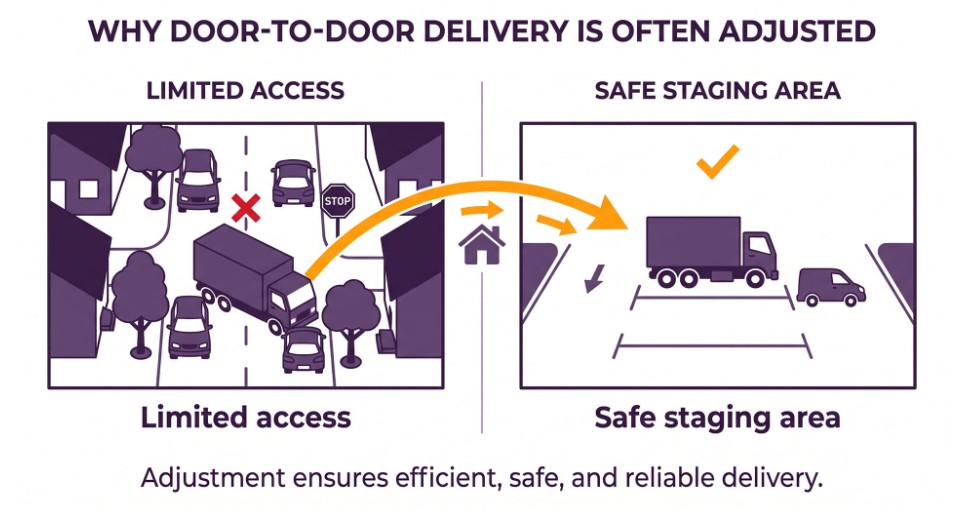
The idea of a truck pulling directly into your driveway sounds incredibly convenient. In many neighborhoods, it is almost impossible physically to execute safely.
Auto transporter is a big piece of equipment, typically measuring 65 to 75ft long. These trucks cannot safely navigate tight residential corners, avoid low hanging branches, or turn around in a standard cul de sac.
What really happens in door to door car shipping is that the driver assesses the local route and finds the closest safe staging area. They will usually call you ahead of time and ask you to meet them at a nearby supermarket parking lot or a wide commercial street. This keeps the truck moving legaly and prevents property damage to local infrastructure.
It ultimately makes the loading and pickup process faster and safer for everyone involved.
What is happening before pickup
The price quote you receive online is just a mathematical estimate, not a dispatched truck. Many car owners do not realize that the company taking their order is often a broker rather than the physical transport carrier.
A broker arranges the transportation but does not own the trucks or employ the drivers. By law, property brokers operate under strict financial guidelines, but their main job is sourcing capacity. Once you book an order the actual operational work begins behind the scenes.
The broker has to find a carrier with the right equipment, the right route, and available space on their trailer. This separation between booking and hauling is why understanding who handles the sourcing matters.
A responsible logistics provider like Rivalane will focus on verifying carrier safety records and legal capacity before confirming the move, rather than just selling the cheapest route..
If a booking agent forces a bad match just to hit a tight deadline, the risk of delays and equipment problems goes up significantly.
Why vehicle setup changes the whole job
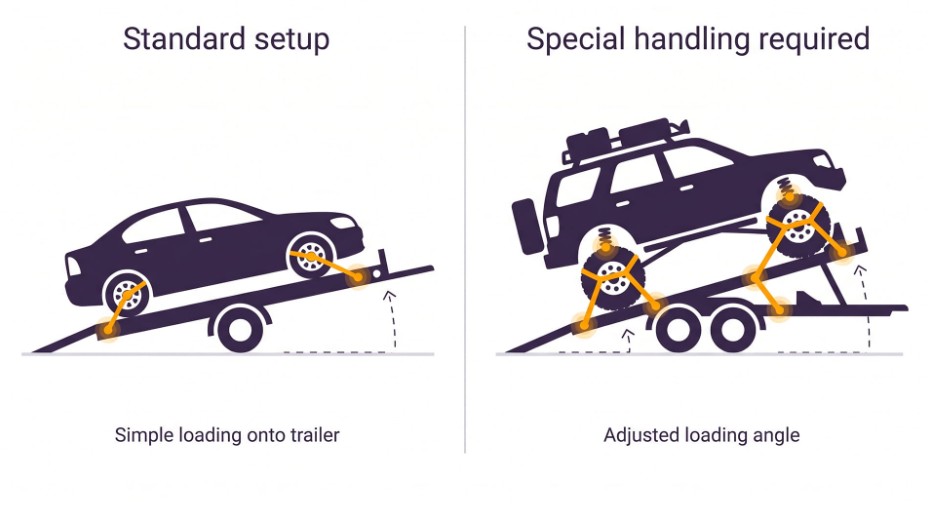
A standard commuter car is the easiest type of cargo to transport. For owners of modified vehicles or off road 4 x 4, the standard transport rules do not always apply. Adding a suspension lift kit, oversized tires, or heavy roof gear changes the physical geometry of the vehicle. These modifications alter the loading angle and the deck clearance required to safely put the vehicle on a multi car trailer.
A truck dispatcher has to place modified vehicles in specific spots on the trailer to balance the overall load and ensure standard tie down straps can reach the axles. Transport regulations require cargo to be secured against shifting under heavy forces, including strong forward deceleration.
If your vehicle has non standard parts, roof tents, or winches, it forces the driver to use different tie down methods and spend extra time adjusting straps to accommodate the higher center of gravity. This extra physical labor and staging complexity is why modified vehicles usually require special attention and cost more to route.
What actually moves the price up or down
Many car owners chase the lowest possible quote without understanding what drives the transport cost. Shipping prices are not fixed numbers on a menu!
They are heavily influenced by the broader freight market, diesel fuel volatility, and available truck capacity in your specific region. When you demand a rigid pickup date, you force the dispatcher to find a truck immediately, regardless of fuel costs or route efficiency. If you offer a flexible window of a few days, the dispatcher can fit your vehicle into a route that makes economic sense for the carrier.
Trucks buy fuel in the same volatile market as everyone else, and their operating costs dictate their rates. Urban locations have access friction, while rural locations have scarcity because there are fewer vehicles to combine on the same trailer. Offering flexibility allows the logistics system to take those costs naturally.
This usually results in a better overall price and a much more reliable transport experience.
How damage prevention works in real transport
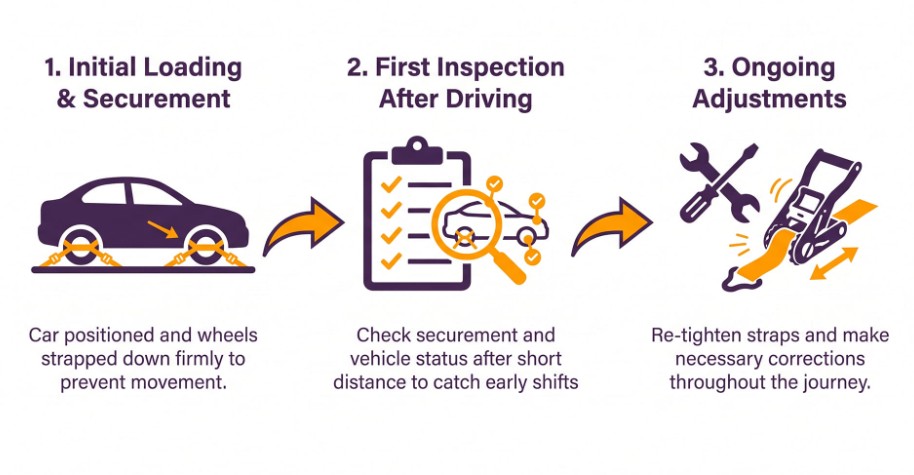
People often think having an insurance policy is the only thing that protects a vehicle from damage. Insurance is just financial paperwork for after a problem happens.
The real damage prevention is an active physical process governed by strict securement rules. Drivers are legally required to inspect the cargo and securement devices within the first fifty miles of a trip.
If straps loosen as the truck vibrates down the highway, the driver has to pull over and readjust everything immediately. Loading a car is a highly regulated handling step, not a quick toss of the keys.
The driver spends significant time ensuring the vehicle will not shift forward or backward during sudden stops or evasive maneuvers. This careful repetitive process takes time, which is one of the main reasons professional vehicle handling feels slower than most customers expect.
Why the actual carrier matters more than the quote
Comparing a dozen different quotes feels like doing thorough research. The actual estimate document matters very little if the underlying carrier has a poor safety record. Every official commercial carrier has a public safety profile that tracks their crash data, inspection summaries, and severe regulatory violations.
When a truck gets pulled over for a routine highway inspection, the condition of their equipment and their adherence to driver hours are recorded permanently.
The initial quote gets the process started, but the physical carrier is the one responsible for the safe transit of your vehicle. Ignoring the carrier history in favor of saving a few dollars exposes your vehicle to higher risks of mechanical breakdowns or getting detained at a weigh station.
Focusing on the safety record of the company that physically moves the car yields a smoother and safer outcome.
The process of moving a vehicle is built around great machinery, space, and safety.. It is not a ‘flawless’ system, and delays happen because traffic, weather, and legal driving limits are part of the daily reality.
Preparing your car for transport is really about understanding these operational constraints. When you know why a driver asks to meet in a parking lot or why a lifted vehicle takes longer to load, the whole process makes perfect sense.
You can plan better, stress less, and let the transport system do what it is designed to do.